Key instrumentation challenges in single-use concentration
Single-use TFF concentration is challenging because you are trying to achieve tight process control in a system that intentionally replaces traditional sanitary stainless-steel instrumentation with disposable components. For biologics concentration specifically, TMP control, flow measurement, and real-time concentration monitoring are the instrumentation topics that create the most operational risk and offer the greatest opportunity for improvement.
Transmembrane pressure (TMP) measurement accuracy and control: In concentration TFF, transmembrane pressure (TMP) is often the most critical process variable. Disposable pressure sensors generally have lower accuracy and stability than permanent hygienic transmitters. Pressure drift can lead to incorrect TMP calculations. Air bubbles in single-use tubing cause noisy signals.
Reliable flow measurement: Single-use TFF systems often rely on peristaltic pumps, diaphragm pumps and disposable tubing. These can create pulsation, variable tubing elasticity and pump-induced flow uncertainty. Traditional magmeters cannot simply be installed in disposable tubing.
Concentration end-point detection: Determining when target concentration is reached is a major challenge. Single-use systems rarely contain a full PAT sensor suite. As a result, operators may rely on offline sampling, which makes control become semi-automatic.
Air Management and bubble detection: Air is one of the most underestimated TFF problems and can lead to flow measurement errors, pressure fluctuations and membrane damage. Most single-use TFF skids do not have sophisticated inline bubble-detection instrumentation.
Single-use portfolio highlights
Explore our innovations for single-use concentration process
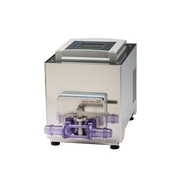
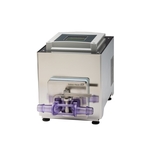
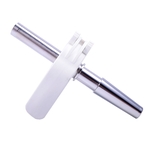
Besides the flowmeter Promass U 500, Endress+Hauser offers Raman spectroscopy analysis tools and a capacitive foam detector for single-use biopharmaceutical applications
/
FAQ
Frequent questions on fermentation in single-use concentration TFF/UFDF